
Retirement Planning in Canada

A retirement plan that knows your RRSP from your TFSA

Start Planning

Set your plan to Canada, choose your province, and Ready Aim Retire plans with the accounts and benefits you actually have: RRSPs, RRIFs and TFSAs, CPP and OAS, and a federal and provincial tax return for every year.

Enter your balances and your Service Canada estimates. The planner works out your RRIF minimums, your OAS recovery tax and, for a couple, how to split pension income between your two returns.
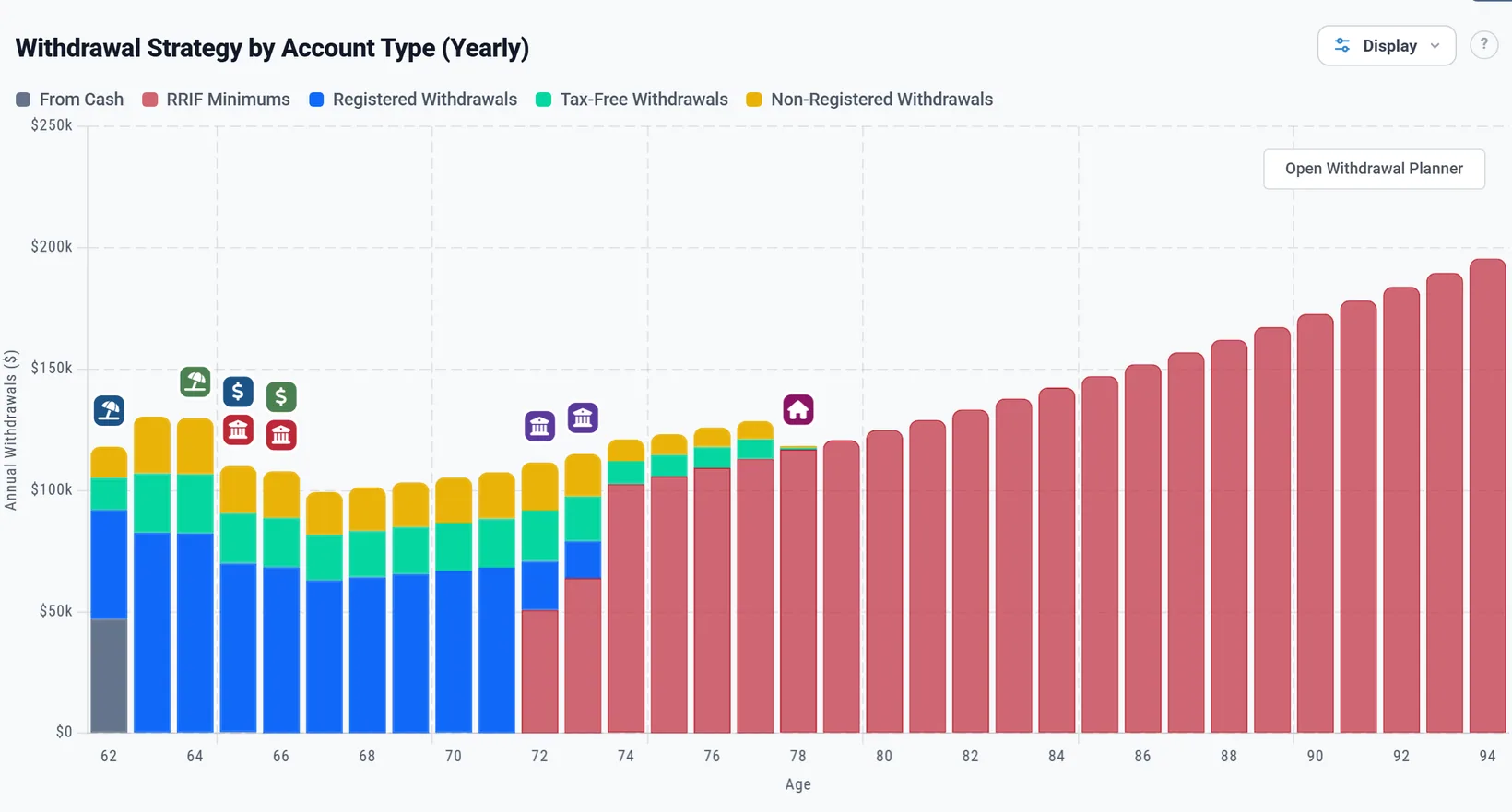
Withdrawals by account type, year by year, in a Canadian plan: cash first at 62, then Registered, Tax-Free and Non-Registered withdrawals to 71, and RRIF minimums from 72 that grow to about $195,000 a year by 94

Where the money comes from each year in Chris and Jamie's plan, switched to Canada. They are a made-up couple we use in our examples.

Your Province, Your Accounts

RRSP, TFSA and more, taxed the Canadian way

Choose Canada under Location in your profile, then your province or territory. Every one is in the list. Your accounts then sort into three groups:

  • Registered: RRSP, RRIF, LIRA, LIF, Group RRSP, DCPP and PRPP. Every withdrawal is taxed as income.
  • Tax-Free: TFSA and FHSA. Withdrawals aren't taxed, and don't count toward the OAS recovery tax.
  • Non-Registered: Non-Registered and joint accounts, RESP and RDSP. Only the gain is taxed, at the 50% inclusion rate.

Interest and dividends in Non-Registered accounts are taxed each year, and eligible Canadian dividends get the gross-up and the federal dividend tax credit. Charts and tables use the words you know: Provincial Tax, OAS Recovery Tax, CPP + EI and RRIF minimums.
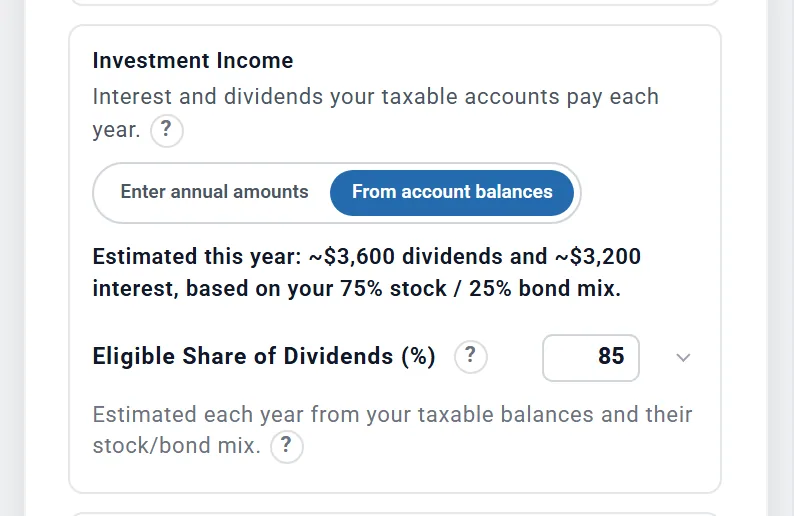
The Investment Income card in the Taxes box: interest and dividends estimated from account balances, about $3,600 of dividends and $3,200 of interest this year based on a 75% stock and 25% bond mix, with the eligible share of dividends set to 85%

Interest and dividends, estimated from your balances. Example amounts.
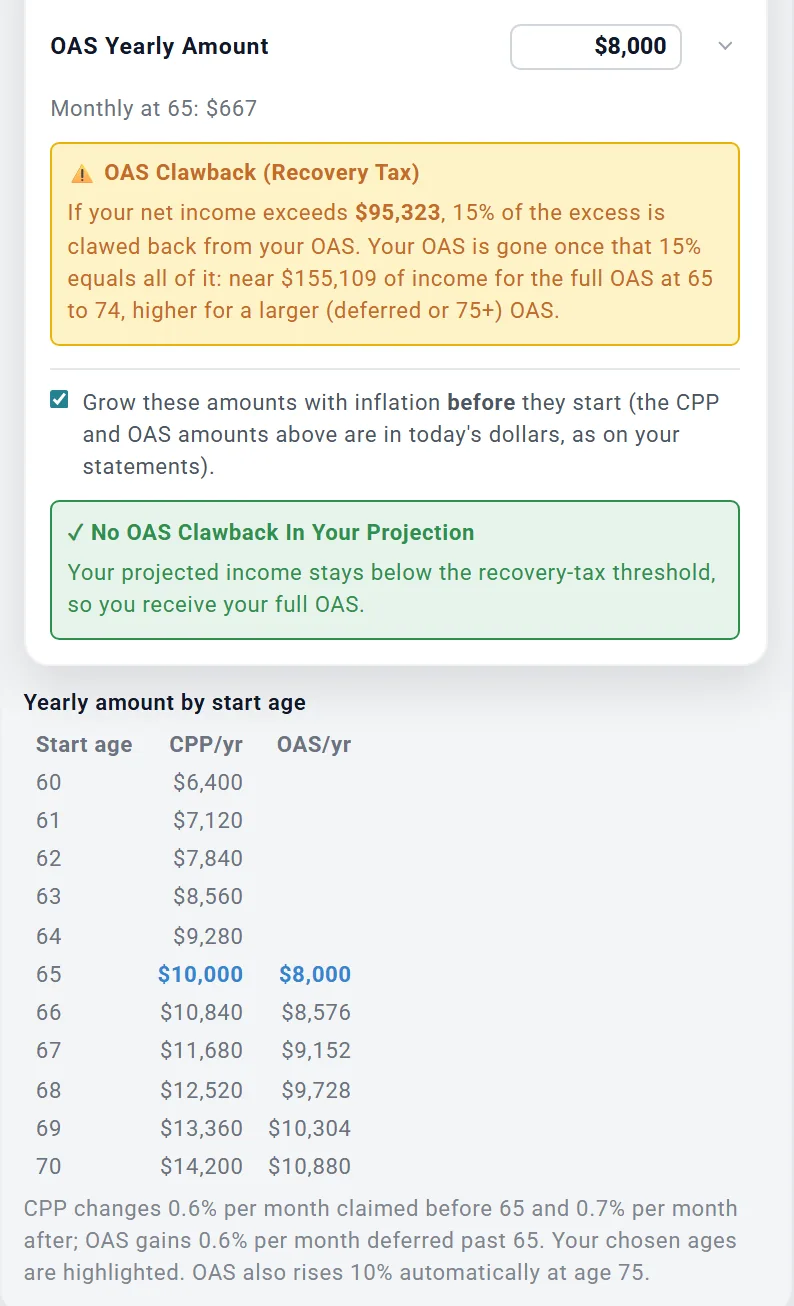
The CPP/OAS box: the OAS Clawback (Recovery Tax) note with the $95,323 threshold, the tick to grow the amounts with inflation before they start, a green note saying there is no OAS clawback in this projection, and a table of the yearly CPP and OAS amounts for each start age from 60 to 70

The CPP/OAS box, with example amounts.

CPP, OAS and GIS

Your government pensions, at the age you choose

Enter each yearly amount from your Service Canada estimate, in one CPP/OAS box for each of you, and pick your start ages. The planner adjusts the amounts for you:

  • CPP from 60 to 70: 0.6% less for each month before 65, 0.7% more for each month after
  • OAS from 65 to 70: 0.6% more for each month after 65, and 10% more once you are 75
  • Quebec: enter your QPP amount in the CPP fields, with a start age as late as 72
  • The OAS recovery tax is worked out on each person's own income, and the box tells you whether your plan meets it
  • The Guaranteed Income Supplement is added by itself, tax-free, for anyone 65 or older on OAS whose income is low enough

A table on the box shows the yearly amount at every start age, so you can see what waiting is worth.

How government pensions are planned

Federal and Provincial Tax

A Canadian return, for each of you

Every year of your plan gets its own return, federal and provincial, priced on the year's actual total.

  • Federal: the 2026 brackets, less the Basic Personal Amount, the Age Amount, the Pension Income Amount and the dividend tax credit
  • Provincial: your province's own brackets and credits, with Ontario's surtax and Health Premium, and Quebec's 16.5% federal abatement
  • While you work: CPP and EI on your pay, or QPP in Quebec
  • Couples: two returns, each with your own credits and your own OAS recovery tax

Pension income splitting is on for new plans. The planner moves up to half of one spouse's eligible pension income to the other, and chooses the split for you. When the OAS recovery tax is in play, it tries other splits and keeps the one with the least income tax and recovery tax together. In Chris and Jamie's plan, turning splitting off adds about $82,000 of income tax over their plan, in future dollars.
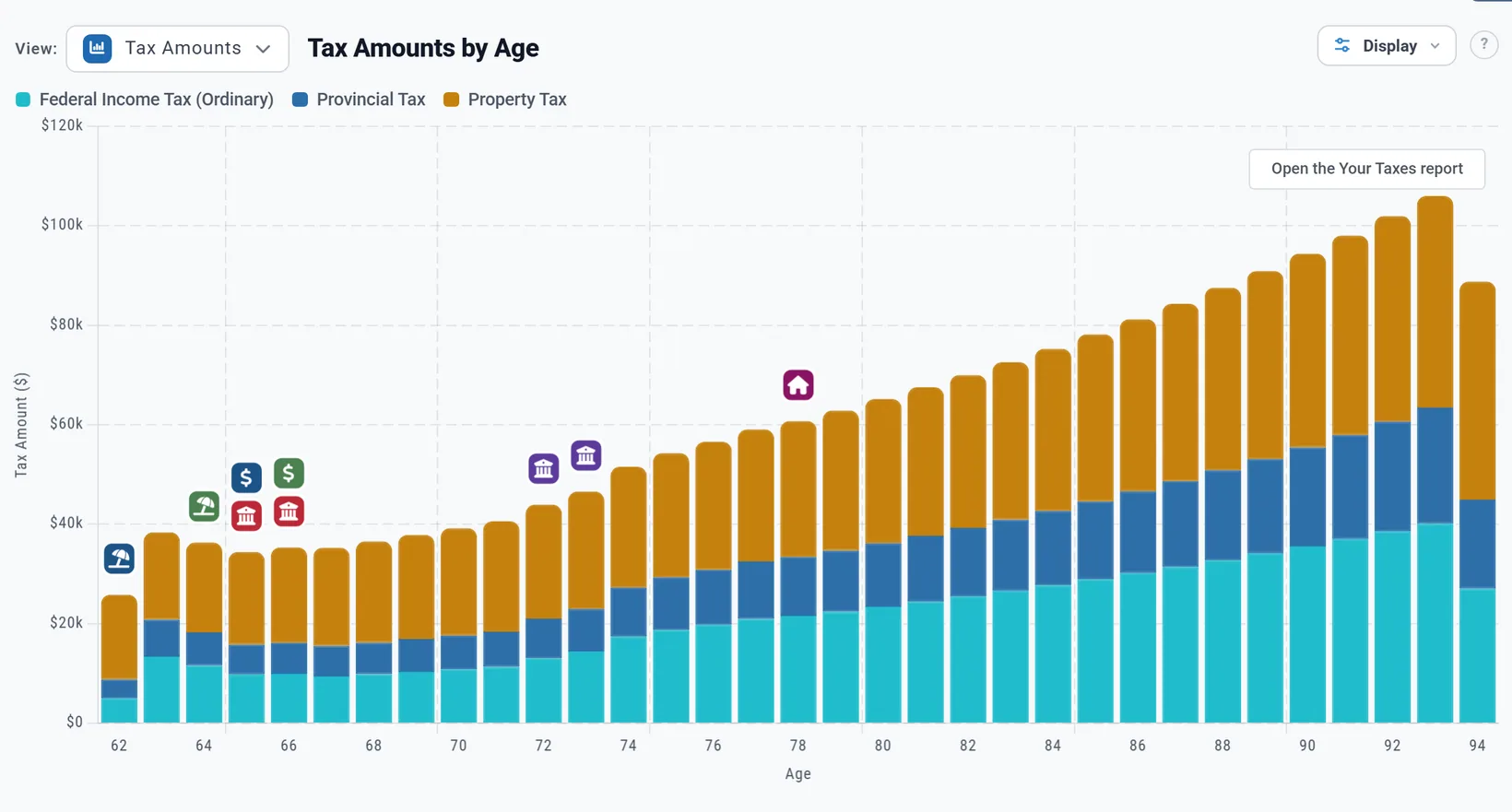
Tax Amounts by Age for a Canadian plan: federal income tax, provincial tax and property tax from age 62 to 94, rising from about $25,000 to over $100,000 a year

Chris and Jamie's taxes by age in Ontario: federal, provincial and property tax.
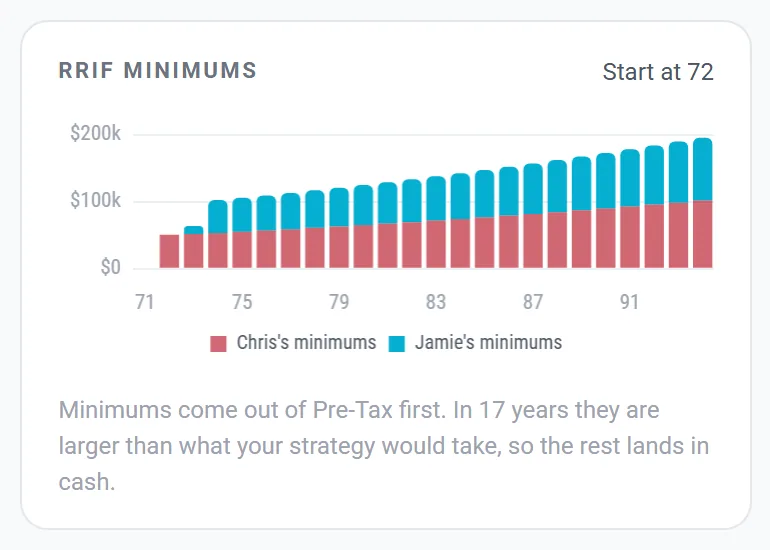
The RRIF Minimums card on the Withdrawal Planner: Chris's and Jamie's minimums from 72, rising to almost $200,000 a year together, with a note that in 17 years they are larger than the strategy would take, so the rest lands in cash

Chris's and Jamie's RRIF minimums, on the Withdrawal Planner.

RRIF Minimums

See your RRIF minimums years before they start

The planner treats every Registered account as a RRIF from 72. Each person's minimums start in the month they turn 72, on their own age and their own balances, at 5.28% in the first year and rising each year to 20% from 96.

  • Minimums come out of Registered money first, whatever your withdrawal order
  • A minimum bigger than your spending is still taken and taxed, and the planner tells you in how many years that happens
  • At the first death, the survivor takes over the Registered balances as their own
  • For a couple, a working spouse's retirement accounts are used only when nothing else can pay the month

Everything else about your withdrawals works as it does anywhere in the planner: cash first, then the order you choose.

Saving with CRA limits

In Advanced contributions, each person's deposits are capped at the CRA limits, rising each year with inflation:

  • RRSP: $33,810 in 2026, or 18% of your pay, shared with a Group RRSP, DCPP and PRPP
  • TFSA: $7,000
  • FHSA: $8,000

RRSP contributions stop after the year you turn 71, and money over a limit goes to your Non-Registered account. Carry-forward room isn't tracked, so your real room may be higher.

How saving is planned

An estate priced on a final return

At the end of your plan, the Estate tab prices the death-year tax as one final return, with Canadian rules.

  • RRSP and RRIF balances count as income
  • Other capital property is treated as sold
  • Your principal residence and TFSAs are exempt

Probate fees, such as Ontario's estate administration tax, are not worked out.

The Optimizer, for Canadian plans

The Optimizer tests every withdrawal order on your plan, with extra RRSP and RRIF withdrawals that fill the 14% or 20.5% federal bracket in your lower-income years. Once OAS starts, the OAS clawback caps the 20.5% fill.

For a couple, it tries your plan with and without pension income splitting. The biggest benefit is usually in the years before CPP, OAS and RRIF minimums begin.

US-Only Features

What you won't see in a Canadian plan

US boxes are switched off and hidden when you choose Canada:

  • Social Security, with CPP and OAS in its place
  • Roth conversions, with bracket filling in their place
  • The Health Care box: no marketplace (ACA), Medicare or IRMAA costs, so add your health costs to your spending or budget
  • HSAs, US state tax, and the 10% early-withdrawal penalty

Planning in the UK  ·  All features

Good to Know

What the planner leaves out

  • LIRA and LIF lock-in, and LIF maximums
  • Spousal RRSPs, the Home Buyers' Plan, and TFSA room given back after a withdrawal
  • RESP and RDSP grants and bonds
  • CPP survivor benefits and CPP sharing: when one of you dies, their CPP and OAS stop
  • Provincial dividend tax credits, so dividend tax runs a little high

Chance of Success replays US market history and US inflation, as there is no Canadian data yet, and it says so in a note.

Preview Free to get started

  • Setting your plan to Canada and choosing your province or territory
  • The CPP/OAS boxes, with your own amounts, and Defined Benefit Pension 1 and 2
  • The Optimizer and bracket filling
  • The Contribution Planner: view it and type your amounts

Planner+ Planner+ adds

  • Adding your own accounts: an RRSP, a TFSA or any other
  • Your own amounts in Pension 1 and Pension 2
  • The Estate tab, all of Your Taxes, and every Dashboard chart beyond Portfolio
  • The Contribution Planner's order, Fill to limit and year ranges
Want every detail? Read the full guide, Planning in Canada, in our help center. Read the guide

A projection, not a promise

Your plan uses your own estimates and 2026 federal and provincial tax rules, with brackets that rise with your plan's inflation in later years. Provincial tax is an estimate, and real tax law, benefits and markets will differ. Ready Aim Retire is an educational tool, not tax, legal or investment advice.
Explore & Learn

Take aim at your retirement
with Ready Aim Retire

Sign up today and start building the financial plan you deserve. It's free to get started!

Get Started