

The Hardest Part of Passing on Money Isn't the Money. It's Saying It Out Loud.


A few years back I was sitting on a patio in Lisbon with a guy named Marcus who had just buried his dad after what looked like flawless estate planning. Great guy, sharp as anything, ran a logistics company for thirty years. And Marcus tells me the estate was perfect. Trust was funded. Taxes were handled. The attorney did everything right.
Then he says, "I found out I wasn't getting the house from a stranger in a conference room, and I haven't spoken to my brother since."
That's the whole problem in one sentence. It was never a money problem. It was a family dynamics problem that a perfect estate plan couldn't fix.
The Williams Group spent 20 years tracking 3,200 families through a wealth transfer, asking one question: when family money disappears, where does it go?
- Fewer than 5% of family wealth failures come from investment losses or tax mistakes. About 25% come from unprepared heirs. More than 60% come from a breakdown in family trust and communication.
- 70% of wealthy families lose it by the second generation, 90% by the third, and almost none of it is a portfolio problem.
- The Great Wealth Transfer now stands at $124 trillion through 2048, and $54 trillion of it moves sideways to spouses first, more than 95% to women, before it ever reaches the kids.
- 71% of adult children and 79% of parents say they'd rather talk about inheritance than talk about sex and dating. The taboo is softer than everyone assumes.
Bottom line: the plan isn't finished until you've said it out loud. Start the conversation this quarter, not "someday."
The answer surprised me the first time I read it. Fewer than 5% of failures came from investment losses or tax mistakes. About 25% happened because the heirs were never prepared. And more than 60%, the big chunk, came down to one thing: trust and communication broke down inside the family.
Seventy percent of wealthy families lose it by the second generation. Ninety percent by the third. Almost none of that is a portfolio problem. It's a generational wealth problem, and it starts with silence.
Sit with that for a second, because it should completely change how you think about estate planning. You can hire the best attorney in your state, fund your revocable living trust perfectly, squeeze every last dollar out of the estate tax, and still watch the whole thing fall apart because nobody ever said out loud what the plan was or why you built it that way.
If you're pushing 60 and you haven't had a real conversation with your adult kids about what happens to your stuff, you're not early. You're already behind.
The Number Everybody Keeps Repeating Is Wrong
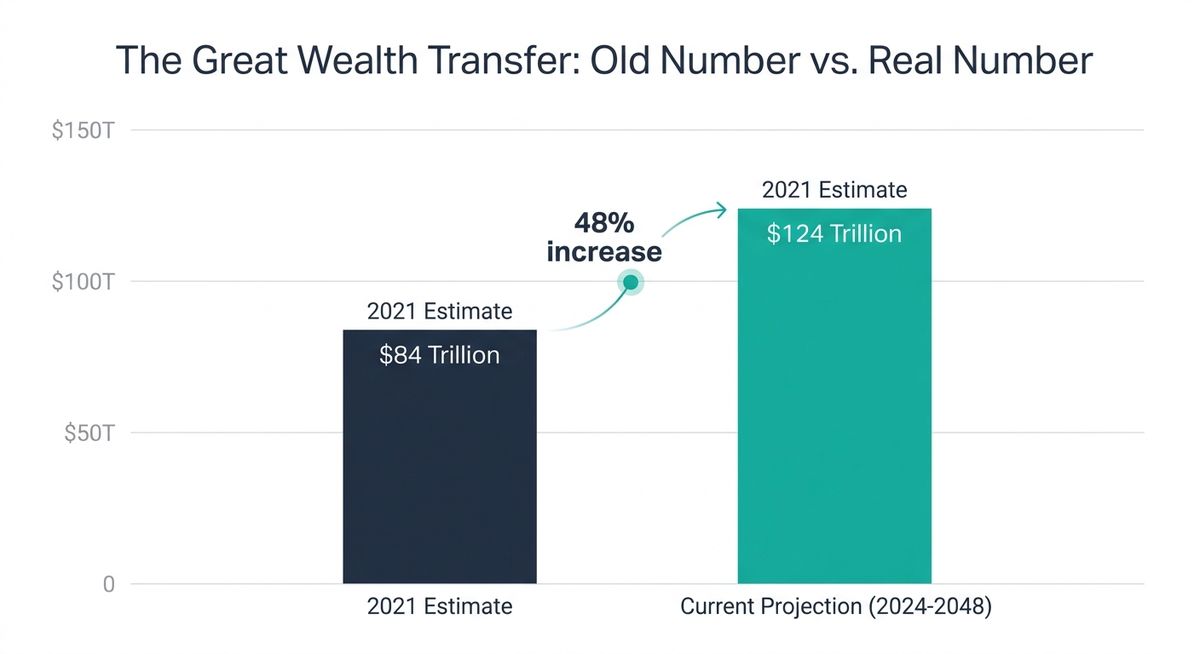
You've seen the figure. $84 trillion in the Great Wealth Transfer. It's in every article, every newsletter, every LinkedIn post from a guy in a quarter-zip.
It's also four years stale.
Cerulli Associates published that number in 2021. Their current projection, covering 2024 through 2048, is $124 trillion. Roughly $105 trillion goes to heirs, $18 trillion to charity. The 48% jump came from inflation rebasing, 27% equity appreciation, 39% real estate appreciation between 2020 and 2023, and wealth continuing to pile up at the top.
A few details from that research matter way more than the headline number:
- 55% of the transfer activity happens between 2026 and 2036. Not someday. Now.
- Boomers and older generations account for about $100 trillion of it, roughly 81% of all transfers.
- Millennials get the biggest slice over the full period, about $46 trillion. But in the next 10 years the bigger flow is $14 trillion heading to Gen X.
- Home equity by itself is projected at $17.2 trillion between 2026 and 2045. That's $859 billion a year.
If you want to see how timing, appreciation, or a transfer landing earlier or later actually changes your own family's numbers, you can run those projections for your own situation at ReadyAimRetire.com rather than eyeballing a national average and hoping it applies to you.
And here's the part almost nobody writes about.
The First Transfer Usually Isn't to the Kids
Of that $124 trillion, roughly $54 trillion moves sideways to spouses first. More than 95% of it goes to women. About $40 trillion lands with widowed women in the Boomer and Silent generations.
Think about what that means. Every "talk to your children" article quietly assumes both parents die at the same time, like a movie ending. That's not how it works. One spouse dies. The survivor runs the entire estate alone for anywhere from six months to twenty years, and what happens when one spouse handles all the finances is its own kind of crisis, separate from anything the estate plan accounted for. Only then does anything reach the kids.
Which makes Fidelity's 2025 Family & Finance Study a little tough to read. Among the women they surveyed, only 30% had a will or estate plan. Only 27% had a healthcare power of attorney. Only 24% had a financial power of attorney. Only 16% had planned for future care needs.
But 75% of partnered women said they felt confident they could handle the finances alone if their partner died first.
Confidence is a wonderful thing. Confidence is also not a document.
I'm not picking on anybody here. If you want a head start on what that first year alone actually looks like, our widow's financial survival guide walks through it in detail. If the estate plan lives inside one spouse's head, the plan dies with that spouse.

The Portability Trap
The federal exemption is portable between spouses. Several state estate taxes are not. Washington is the clearest case: no portability at all. A couple that leaves everything outright to the survivor can waste the first spouse's entire $3 million exclusion. That's a planning mistake you make by doing nothing, in total silence, without ever making a decision.
So before you schedule the big family meeting, schedule the small one. Just you and your spouse. Both of you should know where the documents live, who the attorney is, what the passwords are, and what happens in the first 90 days if one of you is suddenly gone.
Why Nobody Ever Has This Conversation
The data on family silence is weirdly consistent no matter who's doing the survey.
Fidelity talked to parents 55 and older with at least $500,000 in investable assets and adult kids between 25 and 54. Seventy percent had a will or estate plan. Good. But 68% had not shared a single inheritance detail with their children. Fifty-two percent had never discussed net worth. Ninety-seven percent of families said these conversations matter, and nearly half had never had one.
Kiplinger and Morning Consult surveyed 5,156 Americans. Two in five families have never discussed inheritance plans at all. Three in 10 parents have no formal plan. When they asked people to rank topics by how comfortable they felt talking about them, inheritance came in second to last.
The only thing that ranked lower was sex and dating.
71% of adult children and 79% of parents said they'd rather talk about the inheritance than talk about sex and dating.
Read that again. The taboo is real, and it's also a lot softer than the people stuck inside it believe. Both generations are sitting there waiting for the other one to bring it up first. It's a standoff where everyone wants the same thing.
And the silence costs you something you can actually measure.
What Parents Expect
47% expect to leave a meaningful inheritance.
What Kids Expect
Only 24% expect to receive one.
So some of those kids are under-saving for money that's coming, and some are counting on money that isn't. Nobody can tell which group they're in, because nobody has asked.
Bank of America found that 89% of Boomers agree the conversation is important. Only 39% have had it. Nearly 20% of Boomers and Gen Xers say their family doesn't even know whether a will exists.
Timothy Habbershon, who founded the Fidelity Center for Family Engagement, puts the trap plainly: "As people get older, especially past 70, they often become less willing to talk about estate planning, long-term care, or how their family can be involved in planning and decision-making."
That's the cruel geometry of this thing. Your willingness to talk drops off right as the stakes climb. One advisor told CNBC something that stuck with me: "You're waiting for the perfect moment to have that talk, and it just never arrives."
Meanwhile the basics are getting worse, not better. Caring.com's 2025 study found only 24% of Americans have a will, down from 33% in 2022. The number one reason people give, every single year since 2022, is that they "hadn't gotten around to it." And the most common thing that finally gets them moving? A medical diagnosis.
I don't love that as a planning trigger.
Fair vs. Equal: The Sweat Equity Thing
Kiplinger found that 71% of parents with more than one child plan to split everything equally. And look, I get it. Equal feels like the only decent choice. If your assets are a house and a couple of brokerage accounts, equal usually is fair.
It stops being fair the second one kid has built sweat equity into the business the other two never touched.
You've seen this version. Three adult children. One stayed home to run the company or the farm, took below-market pay for ten years, put the profits back in, and personally signed for the operating line of credit. The other two built careers somewhere else, which is also a completely fine choice.
Now split the company into three equal voting shares. What did you just create? A controlling shareholder who can't make a single decision without two siblings signing off, siblings who have never spent a day in the business. Plus two people holding stock in a company they can't sell to anyone.
That's not fairness. That's a slow-motion family argument with a corporate structure attached.
The professional term for the fix is estate equalization, and the toolkit is well established:
Life Insurance
The business equity goes to the kid running it. A policy names the other children as beneficiaries and delivers comparable value without splitting up control. Get a real appraisal first so the coverage actually matches what the business is worth.
Buy-Sell Agreement
Funded with life insurance, it sets fair market value ahead of time and guarantees there's cash sitting there at exactly the moment somebody needs it.
Installment Sale
The operating kid buys out the siblings over a period of years. Be honest about the downside: it drains business income for a decade and ties the other siblings' checks to how well their brother or sister runs the company, which can rebuild the exact resentment you were trying to prevent.
The stakes aren't hypothetical. The most-quoted figures, which trace back to a 2003 Astrachan study and get repeated everywhere with no attribution, say 30% of U.S. family businesses make it into the second generation, 12% into the third, 3% into the fourth. I'd treat those as directional, not gospel. The planning gap underneath them is better documented anyway: 72% of family business owners want the business to stay in the family, only 34% have a documented succession plan, and nearly two-thirds have no plan that is both written down and actually communicated.
Farms are in rougher shape. The average American farmer is 58.1 years old. The average farmland owner is over 70. Nearly 70% of farmers intended to transition their operations by 2025, but only one in four has done any formal succession planning. An estimated 70% of U.S. farmland changes hands in the next 20 years.
Business and farm succession needs to start five to 10 years before you walk away. Selling a business is nothing like selling a brokerage account. You've got key employees to keep, customer relationships to hand off, debt to refinance, and a valuation that partly depends on you still being around to explain the place.
Here's a quick four-question test for whether "equal" is really fair in your family:
- Is a big chunk of your net worth locked up in an illiquid operating asset?
- Has one kid taken below-market pay or personal risk to build that asset?
- Can you make the other heirs whole with cash or life insurance instead?
- Have you told all of them your reasoning?
Number four is where families fall apart. A dad who leaves the business to the older son and a modest cash inheritance to the younger one may have made a completely defensible call. But when the younger son hears it for the first time from an attorney reading a document out loud, he doesn't hear a business rationale. He hears a verdict on what he was worth to his father.
The estrangement isn't caused by the unequal split. It's caused by the silence wrapped around it.

The Cabin Isn't a Gift Unless You Fund It
Family vacation homes are the asset people least want to plan for, and I understand why. Planning feels like you're desecrating something. The lake house is where the grandkids learned to swim. Nobody wants to sit down and talk about forming an LLC around a place that smells like pine and old sunscreen.
Run the numbers anyway.
Maintenance alone typically runs 1% to 2% of a home's value every year, and that's before property taxes, insurance, and utilities. One commonly cited real-world example sits at the modest end: $18,000 a year for a paid-off vacation home the family used four weeks out of the year. A paid-off property in the $500,000 to $1.5 million range more realistically runs $20,000 to $50,000 annually, and that's before anything big breaks.
Now take the modest version and split it three ways among kids with different incomes, different zip codes, and different feelings about the place. One wants to use it every weekend. One lives 2,000 miles away and cannot possibly justify $6,000 a year for somewhere they visit once. One wants their share in cash to knock down a mortgage.
Congratulations, you just turned a beloved family asset into a recurring bill that two-thirds of your children quietly resent.
There's also a trap almost nobody warns you about: in some places, transferring title triggers a property tax reassessment. Your nice capped assessment resets to current market value, and the carrying cost jumps at the exact moment your kids inherit it.
Leaving the property to adult siblings as tenants in common with no operating agreement is how you end up in a partition action, which is a fancy way of saying a judge forces a sale. Partition filings are climbing as Boomer real estate moves down a generation. A partition action is what "ah, they'll figure it out" turns into.
If you want the cabin to outlive you, it needs structure:
- Title held by an LLC or a dedicated cabin trust, not tenants in common. One administrative note that's actually good news: FinCEN issued a final rule on August 11, 2026, effective August 14, 2026, permanently eliminating beneficial ownership reporting for U.S.-formed entities and U.S. persons. Only certain foreign entities still file. A family LLC is a lot simpler to maintain than it was back in 2024.
- A funded maintenance reserve, ideally seeded while you're alive, so the place isn't a bill your lowest-earning kid can't cover.
- A right of first refusal so the remaining siblings can buy out whoever wants out, at a price you set in advance, optionally at a discount, optionally on a payment plan.
- Automatic transfer triggers for incapacity, divorce, or just plain not paying your share of the expenses. That last one is the provision that actually stops the feud before it starts.
- A written usage and scheduling protocol, plus a clear rule on whether a deceased co-owner's share goes to their own kids or gets offered back to the siblings.
One big caution before you go transferring the cabin to everybody tomorrow. Property you still own when you die gets a basis step-up to fair market value, which can wipe out decades of capital gain. Property you gift away carries your original basis right along with it. On a cabin you bought in 1988, that difference can be far bigger than anything you'd save avoiding probate.
So structure the ownership. Think hard before you speed up the transfer.
The Trust Fund Baby Worry, With Actual Numbers
The most common reason parents stay quiet is the fear that transparency will kill their kids' drive. If they know what's coming, will they still push?
It's a fair worry. My man David asked me almost exactly that at a barbecue last summer, and he wasn't being dramatic about it. He genuinely didn't want to hand his son a reason to coast.
Fidelity put numbers on that worry.
Adult Children
95% say they're ready to manage an inheritance.
Their Parents
25% disagree.
Both halves are worth sitting with. The parents' fear isn't crazy: a quarter of them honestly doubt their kids are ready. But the kids are almost unanimous that they've got it handled. That gap does not close by itself, and it isn't really a financial literacy problem. It closes exactly one way, which is by talking, because right now neither side has any idea where the other one actually stands.
Silence doesn't prevent the problem. It just pushes it to probate, where your kid finds out what they're getting and what they're supposed to do with it on the same afternoon, from somebody they've never met.
There's a downstream symptom here that the wealth management industry completely misreads, by the way. Cerulli found only 27% of future beneficiaries plan to keep their parents' wealth advisor, and that drops to 20% among people who have already inherited. The industry looks at that and sees a client retention problem.
Look at the reason heirs actually give. Twenty-eight percent say they had no relationship with the advisor at all. That's not retention failure. That's proof the introduction never happened. The people who built the plan and the people who have to live inside it have never been in the same room.
Guardrails are still totally legitimate, to be clear. A trust can protect an inheritance from creditors, from a divorce, and from a 24-year-old's judgment without trying to script an adult's entire life. But estate attorneys are pretty consistent about where the limits are. Conditioning distributions on a specific degree or profession usually just collides with what your kid is actually good at. Conditioning them on avoiding some behavior tends to backfire. And courts will throw out provisions that are unreasonably restrictive, that mess with marriage or religion, or that are just too vague to enforce.
Ruling From the Grave, Cautionary Edition
Leona Helmsley requiring two grandchildren to visit their father's grave every year to keep their money is still the go-to example of ruling from the grave. Don't be that.
The other situation that really punishes silence is remarriage. More than 40% of U.S. families are blended. One in three Americans is a stepparent, stepchild, or stepsibling. Sixty-three percent of remarriages involve stepchildren. And here's the one that catches people: stepchildren do not automatically inherit unless you name them, and it doesn't matter one bit that you raised them from the time they were three.
The "leave everything to my spouse" default is also the single most common way biological children get permanently written out. Assets pass outright to the surviving spouse. That spouse's own plan then leaves everything to their own kids. Litigation follows, and contested probate gets painfully expensive fast.
Put On Your Own Oxygen Mask First
Some families dodge the conversation forever. Others overcorrect and start writing checks: a down payment here, a 529 contribution there, a little help with the car insurance that somehow became permanent.
If you're doing this while also covering costs for an aging parent, you're not alone; our guide on whether a retiree juggling both generations can still afford to retire walks through exactly that math.
The scale of this is bigger than most people think. Half of parents with adult children provide regular financial support, and among those who do, the average is about $1,474 a month. Call it $17,700 a year, according to Savings.com's 2025 survey. Parents still working contribute 2.3 times more to their kids' lifestyle than to their own retirement accounts.
Read that last sentence one more time.
Bankrate found 61% of parents with adult children have sacrificed financially to help them. What goes first: emergency savings (43%), paying off debt (41%), and retirement savings (37%). Those first two are precisely the wrong two to cut, because they're the exact things protecting your retirement security later on.
I'm not saying don't help your kids. Help your kids. Just work backward from your own security before you commit.
The number that usually settles this debate comes from the CareScout/Genworth 2025 Cost of Care Survey:
| Care type | Annual cost |
|---|---|
| Semi-private nursing home room | $114,975 ($315/day) |
| Private nursing home room | $129,575 |
| Assisted living | $74,400 |
| Private duty nursing | $90/hour |
Stress-test your plan against several years of that before you fund anything else. Every family's numbers look different here, so this isn't a one-size-fits-all exercise. Then, if the math still works, make the help explicit; this is where lifetime gifting decisions need to be spelled out, not left implied:
- Is it a gift? The annual gift tax exclusion is $19,000 per recipient in 2026, or $38,000 for a married couple splitting gifts. Bigger gifts don't trigger a tax bill, they just eat into your lifetime exemption and require a gift tax return.
- Is it a loan? Then make it look like one. Under IRC §7872, charge at least the Applicable Federal Rate for the term, write an actual promissory note, and collect the payments. Otherwise the IRS treats the skipped interest as a gift. And more importantly, your other kids will treat the unpaid balance as one.
- Is it an advance on the inheritance? Then say so in writing and put it in the estate documents. An undocumented advance is just a future argument with a scheduled start date.
Generosity that wrecks your own independence eventually becomes your children's problem anyway. That's not a moral point, it's arithmetic.
The Tax Story Changed. Most Articles Never Caught Up.
If you've been losing sleep over the federal estate tax exemption "sunsetting," you can stop. That's done.
The One Big Beautiful Bill Act, signed July 4, 2025, repealed the sunset. The exemption is now $15 million per person and $30 million per married couple for 2026, permanent and indexed for inflation.
But the risk didn't disappear. It just moved to the states. Twelve states plus D.C. impose an estate tax, and their thresholds have nothing to do with the federal number:
| State | Exemption threshold | Top rate |
|---|---|---|
| Oregon | $1 million | 16% |
| Massachusetts | $2 million | 16% |
| Rhode Island | $1.838 million | – |
| Minnesota | $3 million | – |
| Washington | $3 million (no portability, frozen exclusion) | 20% |
| Illinois | $4 million | – |
| New York | $7.35 million | – |
Washington's Whiplash Year
SB 5813 raised the state's top rate to 35% for deaths on or after July 1, 2025, briefly the highest in the country. Then SB 6347, signed March 24, 2026, rolled it back to 20% for deaths on or after July 1, 2026. A Washington family's estate tax exposure changed twice in twelve months. Try building a twenty-year plan around that.
Five states also charge an inheritance tax, where the rate depends on how the beneficiary is related to you: Kentucky, Maryland, Nebraska, New Jersey, and Pennsylvania. Maryland does both.
Here's the punchline. A $3 million estate is completely exempt at the federal level and fully taxable in Oregon. For most families reading this, where you live and where your property sits matters more than the federal number ever will.
Three more rules belong on your list.
Inherited IRAs. The SECURE Act's 10-year rule covers most non-spouse beneficiaries, and final regulations issued July 19, 2024 added a twist: if you die after your required beginning date, your beneficiaries have to take annual RMDs in years one through nine and empty the account by year 10. Those IRS penalty waivers that covered 2021 through 2024? Gone. Enforcement kicked in with the 2025 distribution year. Tell your heirs about this one; our breakdown of the inherited IRA 10-year rule deadline walks through exactly how the penalty works. It's the single most common inherited-account mistake out there.
The step-up in basis is still here. Inherited assets get their cost basis reset to fair market value at death. It's one of the biggest tax benefits anywhere in the code, and it's exactly why "just give it to them now" is often the wrong instinct with appreciated property. Reform proposals pop up in Congress every couple of years. Nothing has passed.
Fund the trust. If you signed a revocable living trust as part of your estate planning, go confirm the assets are actually titled in it. Re-titling real estate runs roughly $200 to $400 per property. An unfunded trust avoids exactly zero probate, and probate usually takes six to 18 months and eats 3% to 7% of the estate.
I've seen people pay an attorney thousands of dollars for a beautiful trust and then never move a single asset into it. It's like buying a great safe and leaving your valuables on the kitchen counter.
Start This Quarter
Eighty-nine percent of wealth management firms call family meetings a wealth transition best practice. When the people who watch this for a living all point at the same thing, it's worth a look.
And you don't need to reveal your net worth to get started. Here's a sequence that works:
A Sequence That Works
- Get your own house in order first. A will, a funded trust if you need one, financial and healthcare powers of attorney, updated beneficiary designations (76% of the next generation wants to know if they're named; only 35% of Boomers think that's worth discussing), and a written plan for digital access. An estimated 16% to 20% of all Bitcoin ever mined is permanently unrecoverable, and dying without sharing credentials is one of the main ways it gets there. A password manager plus a written access plan is now a core estate document, right next to the will.
- Talk to your spouse before you talk to your kids. Especially about the survivor's first year.
- Lead with structure, not numbers. You're not announcing your death. You're handing somebody an instruction manual. The opening line is something close to: "I want to walk you through how this is organized, who to call, and why we set it up this way, while I'm still here to answer questions." You can share the whole architecture, the documents, the advisor, the reasoning, without ever saying a dollar amount.
- Explain the unequal decisions yourself, while you can still answer for them. Every estate professional says the same thing: tell your children your reasoning before they find it in your paperwork.
- Introduce your kids to your advisor and your attorney. Not so they'll keep them. So the plan has a living human attached to it who can explain why it looks the way it does.
- Bring in a neutral third party if the dining room table feels impossible. A financial planner, estate attorney, or family wealth facilitator can run the meeting, absorb the awkwardness, and turn a topic nobody wants to raise into a written roadmap everybody understands.
Fewer than 5% of family wealth failures come from taxes and investments.
Be honest with yourself: you've almost certainly spent more time this year on your portfolio than on the conversation responsible for the other 95%. I have too. It's easier to rebalance an account than to look your kids in the eye and talk about dying.
But Marcus and his brother still don't talk. And the estate plan was perfect.
The perfect moment isn't coming. Pick an imperfect one. This quarter.

Thanks for reading if you made it this far. Peace!
Sources: Cerulli $124T · Cerulli $54T to widows · Fidelity 2025 Family & Finance Study · Kiplinger/Morning Consult · Caring.com 2025 · Morgan Lewis on 2026 exemptions · Ballard Spahr on WA SB 6347 · Stokes Lawrence on WA exemption freeze · FinCEN final rule · CareScout 2025 Cost of Care · Savings.com support study · Bankrate sacrifice survey · Cerulli advisor retention · FBCG on survival statistics